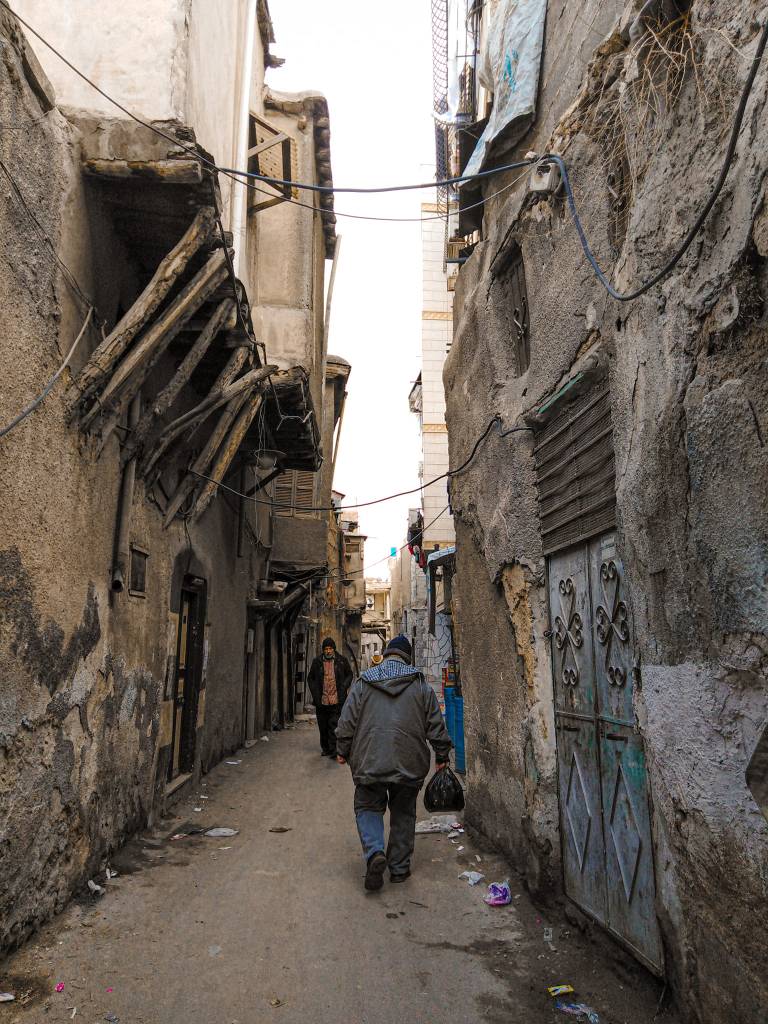
The American Dream

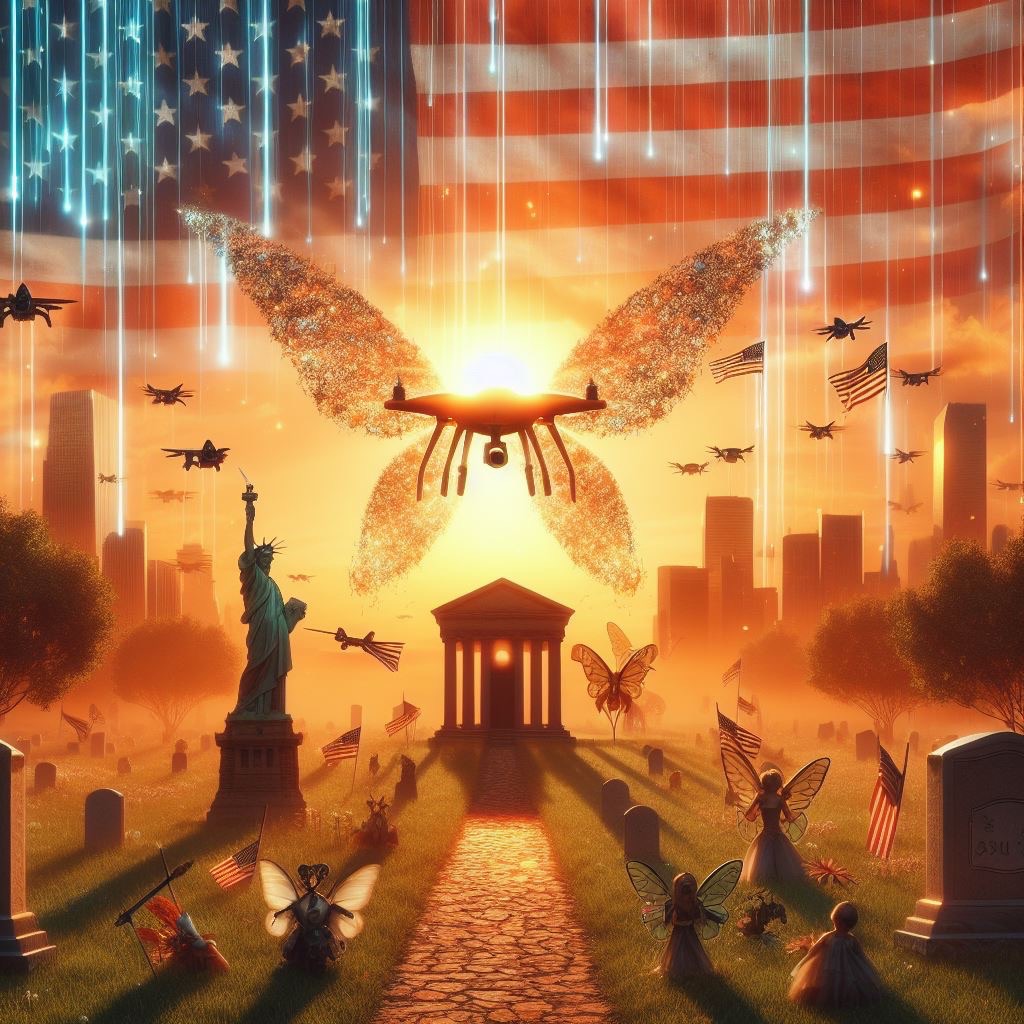
When the Americans do it,

it is complete.

The work of artisans,

the touch of a master.

It hits you like an explosion of flavours,

unexpected:

spicy, never

sweet,

sour.

You learn to appreciate the American

craftsmanship,

with its colours

marinating

the dome of your life.

You learn to see its greatness,

hammered

on your

walls.

When the Americans do it

they do it right.

Nothing,

nothing escapes

their might.

From the past

to your neighbour’s alley,

all get marinated

by the colours,

of the sun’s

fairies:

doom.

Title: Final Stop

Fiction. 2200 words Short Story. OU (Open University)

‘It is safer that way habibi.’

‘But that is too expensive.’

‘Listen habibi. Would you rather risk your life?’

‘No, of course not.’

‘Aha. I am offering you a golden opportunity. I guarantee it.’

‘I know, but—.’

‘No buting habibi. You don’t seem to understand. It is Europe that we are talking about here, and I am offering it to you on a golden platter. Besides, they literally give you money for free there.’

‘I am not going there for money.’

‘I know habibi. But who doesn’t like free money, eh? My cousin went there two years ago and now owns a car!’

‘I am not looking for such a thing either.’

‘You confuse me, habibi. Do you want to go or not?’

‘Yes, I want to.’

‘Tamam habibi. It will cost you 14000 euros. But I like you. You seem like a good guy. If you pay half of it now, I will give you a discount of one thousand. Amazing, eh? 

‘Ok. Ok. Give me a second to get the money.’ he said that, scanned the area around him, grabbed his hoody with both hands and pulled it firmly forward, covering his face from cold and people. Then he wrapped his black scarf around his face, blending himself into the night.

He turned back and headed towards a faded kaki-coloured pile of rags embellished with rusted tin. When he arrived, he cleared one of the rags and pulled it up. The smell of meds and urine attacked his nostrils. He braced himself and got inside the tent. Inside the damp shelter, an amalgamation of bodies huddled together around a flickering candle and the agonised screams of a baby.

‘Hey, you are back!’ said the woman holding the noisy apparition.

‘Yes, and I have some good news.’

‘What did he tell you?’

‘Emmm. I managed to get a discount. But it will cost us 13000. 4000 per adult and 1000 for the baby. But we have to leave at midnight.’

‘But we only have 6000 on us.’

‘Don’t worry. I will handle the rest.’

When the woman heard that, she charged at and grabbed the hand of the young man, pulling it to her face and smearing it with snot and tears and lips.

He pulled his hand away immediately, startled. ‘May God forgive me. No need, Khadija. If we didn’t help each other now, when would we?’

Amidst the sobs, Khadija’s husband rose and started to take off his sweater, revealing a pale, drained waist wrapped with layers of translucent foil. He shredded the sticky wraps of nylon open, releasing his flesh and an envelope hoarded under his armpit. ‘This is all we have. There you can find 6715 euros. Please take them.’

The young man took the envelope, counted 715 Euros, and handed it back before turning around to leave.

‘Wait,’ Khadija’s husband announced, ‘I can’t accept it.’

‘This is not for you,’ said the young man, ‘It is for your sick baby. You still need to take care of him, don’t you?

‘Aren’t’ you going to count the rest?’

‘No need, uncle. I trust your word.’ announced the young man before exiting into the dark, chilling evening, heading back towards the smuggler.

‘Hey. Here is your damn money.’ said the young man, thrusting a bundle at the smuggler’s face.

‘Why! Eh habibi.’ said the smugglers, snatching the money.

‘It is as we agreed, half now and the other half once I am safe.’

‘Of course habibi. But you don’t mind me counting them, do you, eh?’

‘Do what you will.’

‘When you have done this for as long as I have, then you will know.’

‘…’

‘As complete as a straight flush, as an open buffet, as an __.’

‘Are we done here?’ the young man interrupted.

‘khhhhhhh.’ the smuggler snorted, ‘we leave at midnight. Be on time.’

‘We will.’

‘I know you will habibi.’

‘Stop calling me that.’

‘Ok habibi.’

‘My name is Yousef.’

‘OK, Yousef pasha. See you soon.’ spouted the smuggler, waving, and dismissing Yousef before turning around and fading into darkness. Similarly, Yousef turned sideways, strolling into the illegal camp. He put both hands into the side pockets of his khaki jacket and started rummaging for a cigarette when he heard someone calling for him from behind.

‘Yousef, Yousef.’

  Yousef looked back towards the voice.

‘How was it,’ the old man asked.

‘Hello, uncle. It went as expected.’

‘Don’t call me uncle. I am not that old. Call me Ziad.’

‘It doesn’t feel right.’

‘I insist.’ said Ziad.

At that moment, Yousef managed to find a broken cigarette in the upper left pocket on his torso. He put it in his mouth, pulled it out, spat some of the tobacco stuck on the filter, and then put it back in his mouth before rummaging again in his pockets.

Ziad noticed that and gave Yousef a lighter and a packet of imported tobacco.

‘I can’t accept this.’ Yousef said.

‘I am quitting anyway.’ replied Ziad, ‘Besides, I have learned that it is killing me.

Yousef nodded, snatched the packet from Ziad’s hands, put the broken cigarette into the packet, and pulled a brand new one. He brushed it slowly by his nose, savouring its smell before throwing it into his mouth.

‘Is your family ok?’ asked Ziad.

‘I don’t know.’

‘When did you hear from them last?’

‘Around six months ago.’

‘Do you know if they are_’

‘I think so.’ Yousef interrupted.

‘I lost my family as well,’ Ziad replied, ‘two brothers and their families and both of my parents. May Allah have mercy on their souls.’

‘May Allah have mercy on their souls.’ recited Yousef mechanically.

‘Khadija and the baby are all I have now.’

Yousef lit the cigarette, expanded his chest greedily, and felt the nicotine circulating through his body, then oozing into his famished brain.

‘Where are you going?’ asked Ziad.

‘I am not sure yet. The plan is to leave first and then think later. What about you?’

‘Germany. I think. I can find work there. If Allah wills it.’

‘Inshallah. It is a good country. Good luck.’

‘You too.’

‘Listen, I think I am going to rest a little. I recommend you do the same.’ said Yousef before swallowing the last wisps of the satisfying amber and retreating towards his tent.

Just before midnight, Yousef abandoned his tent and headed towards Ziad’s.

‘Come, it is time. Have you got everything?’ asked Yousef as he entered.

‘Khadeja,’ shouted Ziad. ‘We need to leave now. It is time.’

The baby roared back in response.

‘Do you need any help?’ asked Yousef.

‘No, we are alright,’ said Ziad, ‘Go ahead. See you at the checkpoint.’

Yousef left the family and the camp, heading west, wading through abandoned tents. The cloudy black sky made it hard to recognise landmarks, but It wasn’t hard to find the checkpoint. All he had to do was to follow the column of the marching dejects. With his head throbbing with excitement and lack of sleep, he surrendered his fate to the solemn faces around him. They hadn’t marched for long before the column started to slow down, congesting into a shivering jumble. Suddenly, a shushing wave pervaded through the throng, which was interrupted by the cries of forlorn babies.

‘Listen! Listen.’ an agitated voice arose from the centre of the gathering. ‘Shut your babies up. God damn it. Listen. Do not make any sound. Be as silent as a corpse, or you will be one, eh? Now go. Fast and sile —-‘ screamed the man when his rant was broken by a wail.

‘Hey, you. If you can’t control your pet, you better leave it.’ threatened the man.

‘I am sorry, I am sorry.’ said Khadeja. 

‘I wasn’t talking to you, woman. Who is the husband?’

‘Me.’ said Ziad. 

‘Keep your family in check, eh? Silence that small devil, or I will do it for you. Now, get into the boat.’ Spat the man, pointing towards the dark canvas behind him.

Yousef, along with the horde, rushed towards where the man was aiming. But as they clawed their way into the wobbly life-changing deck, someone suggested letting the woman and children go first, to which the people echoed, ‘Yes, of course.’

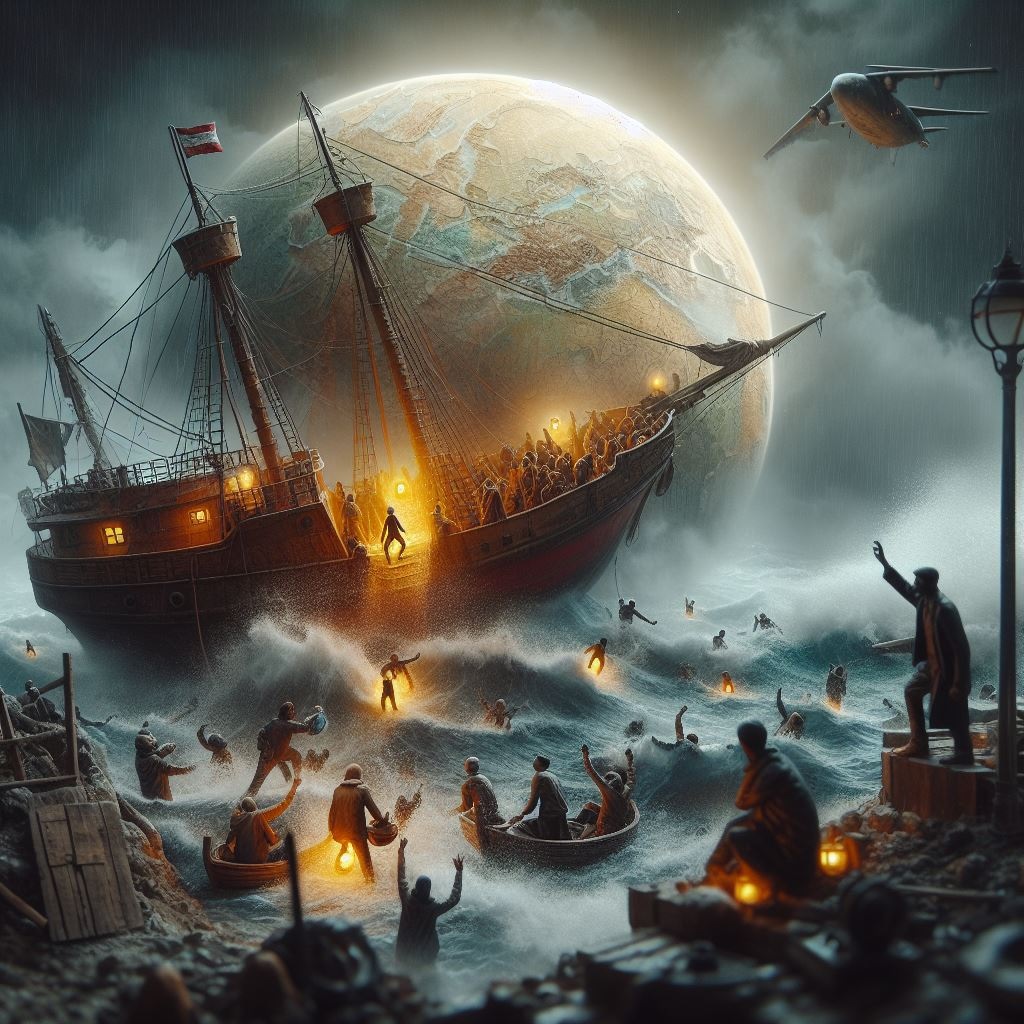
Waiting for the families to board, Yousef stood in silence. He stared at the horizon but saw nothing. The sky and the sea have combined into a mourning titan dyed with pitch. He knew he was at a beach because he heard the titan’s moan, ebbing and flowing, indifferent to the boarding gaggle. But right when he boarded, and just when the boat was about to move, the smuggler grabbed his arm, whispering, “We will disembark at Kos. The boat will continue. Stay with me”, then hovered away like a spectre. The boat jerked and coughed, once, then again, before starting its flimsy pilgrimage into the promised land. Yousef moved through the deck, squeezing his shoulders sideways through heads and torsos, dodging coughs, sneezes, and sighs. He kept at it till he heard Ziad’s voice calling for him. 

‘Yousef. Here, on the side. Come, sit down.’

‘Alhamdulillah, we are finally onboard.’ continued Ziad.

‘Alhamdulillah indeed, but keep your voice low.’ Yousef reminded him. Sitting, he melted into a pile of headaches. But instead of relief, the rubbery deck offered Yousef nothing but naked coldness that seeped through the elastic deck into his clenched jaws.

‘Here, have a cigarette,’ said Ziad, smiling. 

Yousef closed his eyes and bit on the filter, feeling its circular edge with his tongue. He lit it up, siphoning its energy, hoping to revive his own. But as he felt its essence mingle with his own, a swift swipe snatched it away, discarding it into the dark abyss below.

‘What are you doing habibi, eh? Are you trying to kill us? The amber is like a lighthouse here.’

Yousef clenched his jaws again, looked at the smuggler, nodded, and closed his eyes, trying to take his mind away from the drums beating inside his skull.

‘We are about to cross into the Greek waters,’ whispered the smuggler, ‘keep your mouths shut.’

A wave of silence spread rapidly across that merged with the susurration of the boat swishing through the dark waters.

‘Stay put. The tide will carry us to shore.’ said the smuggler softly when a loud shriek exploded from within the dead-silent heap of the mob.

‘Who the fuck was that? It is the damned baby again. Shut it up now, or I will throw all of you away.’ said the smuggler to Ziad.

‘Don’t worry. It will not happen again.’ said Ziad as he gently pressed his palm into the face of the baby, muffling his sobs and driving the struggling baby to hysteria. 

‘it better not.’

‘It will not.’ Ziad retorted.

With that, the silence swallowed the boat again with a gulp.

An hour later, the smuggler approached Yousef.

‘Hey habibi, we will arrive at our stop in half an hour. I will leave the boat. Follow me, eh?’ 

Yousef nodded.

‘Listen,’ the smuggler addressed everyone. We are in Greece now. And we are in shallow waters. We are safe from the coast guards, but keep your mouths shut anyway.’

A sigh of relief spread through the crowd as a condensed drop of a bright colour spreads through pure water.

‘Congratulations, uncle! Congratulations, auntie!’ exclaimed Yousef.

‘Thanks,’ said Khadeja, sobbing, turning around, and hiding her face from Yousef, while holding her silent baby tightly towards her chest.

‘What is the matter?’ asked Yousef.

‘Nothing,’ said Khadeja, ‘really, it’s nothing.’

Ziad put his hand on Yousef’s shoulder and pulled him towards himself.

‘Let her be.’ said Ziad.

‘But…’

‘Just let her be.’

‘Ok, ok,’ said Yousef. ‘Listen, uncle. Ummm…I have to leave soon. But you have to stay. You have to continue by yourself.’

‘But this wasn’t the agreement.’ Ziad answered, looking directly into Yousef’s eyes.

Yousef looked back at Ziad’s and saw them dilate, then contort along with the rest of the muscles of his face into a fearsome mask of exasperation. He looked away, escaping the pouring knives, looking into the sea when he noticed a light flashing nearby.

‘It is our stop habibi.’ said the smuggler before addressing everyone.

‘Stay in the boat. You are just getting a new guide. A better guide, eh.’

On the shore, a stern-looking man with a dark robe and icy blue Greek eyes helped the smuggler stabilise the boat with a rod.

‘Hop off,’ said the smuggler to Yousef.

‘They are your problem now.’ Said the smuggler to the new guide.

The man said nothing, used his rod to push the boat away from the rocky shore, and disappeared gradually into darkness.

‘Here, have a cigarette habibi. Sorry for throwing yours away earlier.

Yousef lit it up, then took a double breath, holding the magic in for a couple of seconds, feeling the nicotine seeping through his countenance.

‘Let’s sleep here now. We can continue tomorrow when the sun is up.’

Yousef nodded in agreement.

‘Habibi, wake up, eh. Are you going to spend your time in Europe sleeping?’ said the smuggler, pulling his mobile phone from his pocket. ‘Here, take these as promised. A French ID and an air ticket.’

‘And this is what I promised.’ said Yousef, handing a bundle to the smuggler.

’57, 58, 59. Clean six thousands.’

‘What’s next?’.

‘Give me a second Habibi. I will check the next train for you.’ answered the smuggler, looking at his mobile before bursting into laughter. ‘Bwahahahahaha.’

‘What is it?’

‘I told you habibi. It is safer with me. It costs 12000 to buy an ID and a ticket, but it is better than that “two k per family” offer.’

‘Why are you saying that now?’

‘Here, look habibi. It is on the news. The boat missed its final stop. Kharon guided them to Hades. Bwahahahaha.’

A Broken Line

Chosen Prompt: Tramlines, Fiction. 2000 words. OU (Open University)

“When I the story of the dreamful youth had found,

It had told of a place both uncouth and unbound;

A place full of the frolic swallows;

Desolate of the painful sallows.

And if you of that story eager to know,

Wallow with me in the callow realms below.”

That day was etched into my psyche and kick-started my consciousness. The sun was at its zenith, looking down at us and lulling life into an intoxicating sleepless sleep when its soliloquy was interrupted by a mirthful voice, pulsing with a static noise, emanating from a wooden box:

“1913 shall be known as a historic day! The century-long-awaited revolution is here! Damascus is walking side by side with the industrialised world. The European ingenuity was commissioned by his majesty Sultan Abdul Hamid; may god prolong his life. The Hejaz railway is finally open to the public. Rejoice, brothers and sisters, we could finally reach Mecca on the wings of revolution”.

“I was a child of four then”, my grandfather had told me.

“We didn’t manage to get rid of our agricultural gown, but the Hejaz station helped us break free from the siege of time on our cities. We felt that we could reach out our hands and grab the world.

“I remember myself”, he continued, “dragging one of my toys behind me: a handmade wooden horse attached to a cord. Leaving my house through the garden, I descend into the back street. It wasn’t a street then. It was a muddy, rocky neighbourhood brimming with wild Cactus and Jasmin. But amidst the arid environs, there lays a new, shiny, and drawn-out object that spanned across in a panoramic view. I run towards it, dragging my horse and bumping it against rocks and vegetation. But when I reach the shiny thing, I bend over with shaky legs and touch it. Its brutal coldness seeps into me, forcing my heart to pump back in resistance through my palm against the cold surface. But the metal replies by shaking the earth below my feet. The vibrations build up within me into a giggle that gets disrupted by the shouts of my mother, followed by a monstrous shriek. I instinctively look to the left, spotting the approaching juggernaut: a black-eyed beast with a steaming nostril, foaming angry smoke in hysteria. I freeze, as you might expect, not in fear but in awe. 

I survive, of course, because my father, alarmed by my mother, rushes over and grabs me by the waist. My old wooden toy gets smashed. I look up, and I see smiling faces waving at me through windows. I laugh”.

“Your great-grandfather was profoundly altered after that day”, my grandfather explained. “Change was approaching, rapid and fast, faster than our people could comprehend. The station was decommissioned in 1920 during the Great Arab Revolt, but the crescendo of developments never ceased to stop. The metaphoric train of revolution kept on going, and its force persisted. It survived through me, and I hereby attempt to kindle it in you”.

This is what I still remember of his story. My grandfather is long gone, but his house and the railway are still there. His story had so passionately altered me that in 2020, I decided, against the advice of my family, to visit the home of my ancestors.

Damascus, during that time, was a city downing in the marches of Styx. With the crescendo of catastrophes playing for a century, she was hanging between worlds in delirium. But when the stifling epidemic gave the war-torn country a breather, the lunatics and the emotionally chained saw an opportunity. I seized that chance. 

I will save you, dear reader, the logistical troubles of my journey to Damascus. But what you ought to know is that I managed to arrive safely. And that I stood right there on the spot that my grandfather spoke of, the spot where progress was rolling, steaming with passion. Below is a detailed account of what I remember:

I leave the taxi three blocks from the decommissioned station because the taxi refuses to drop me any closer, scared for his safety. It is late in the afternoon. Street lamps are off, and shadows are invading corners and alleys.

As I approach the station, I notice its modern occupants: a local militia, a group of young boys claiming to uphold the neighbourhood’s safety. I do not attempt to sneak into the passenger quarter, but I look for an opportunity to get to the courtyard and into the rails without being spotted. Waiting for the sky to put on its concealing garments, I sidestep into one of the alleyways lurking. As I squint, probing the façade, I notice a yellowish moss possessing the building, covering its blackened corners and columns: survivors of bombings and fires. The once majestic herald of progress is now a rabid mule, a burden for its owners. But then I spot a chance. The side fence is unguarded and fully draped with the night shadows. I manage to sneak in, skipping into the courtyard.

I had once imagined it to be a facsimile of Eden, embellished with Arabic calligraphy, adorned with lavish Turkish gardens, and gushing with yodelling fountains. I had envisioned it full of muscled trains capable of dragging enlightenment forcibly across the continents.

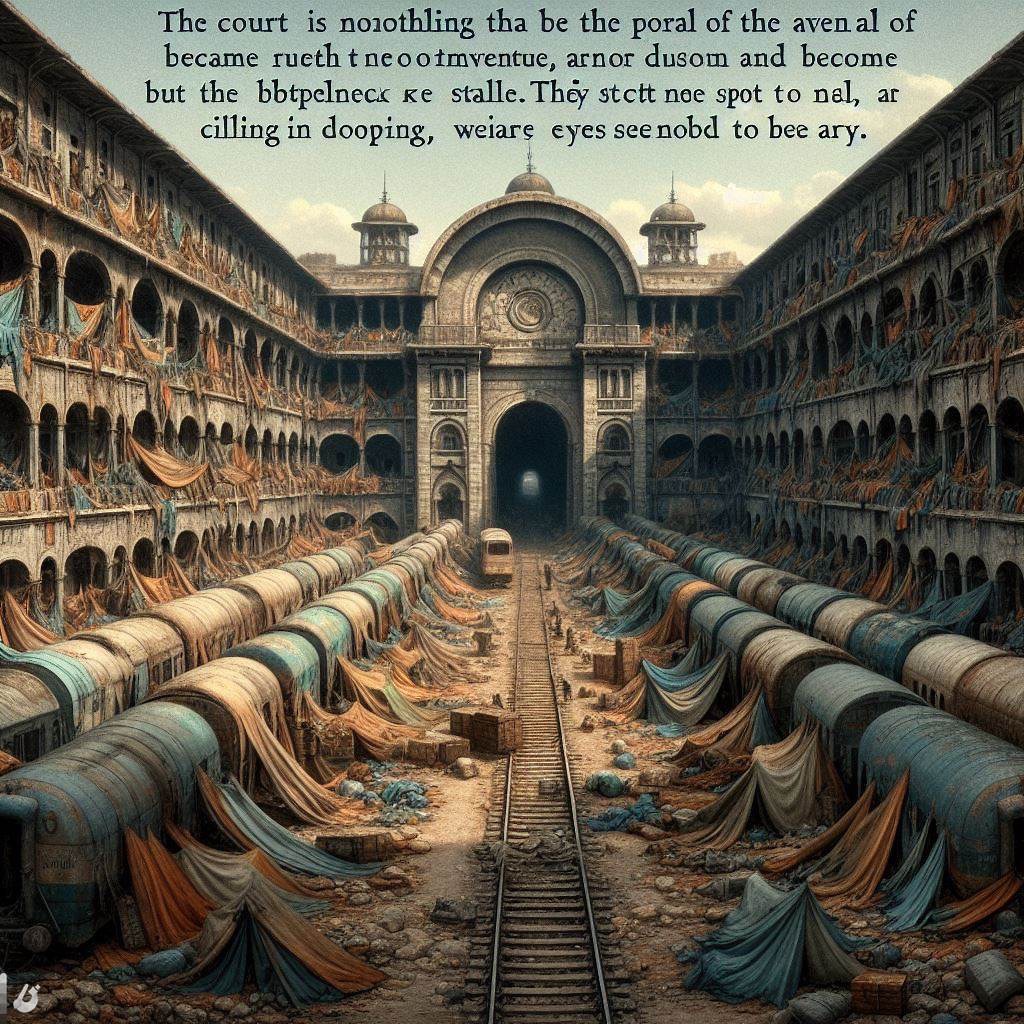
The court is nothing like that. It seized to be the portal for adventure and became the bottleneck of misery. It is stacked with dilapidated tents, full of moving silent skeletons. They spot me, but their drooping, weary eyes seem unable to see me. And what is left of the dismantled trains is but the junk that is hard to sell, pilling in stacks of rusting corpses.

I walk past the tents and towards the rails. It takes a while to find them, or rather what’s left of them: continuous marks of rust marching towards darkness, towards its original destination: Hejaz.

I trudge forward, burdened with thought and anticipation for a good chunk of the night. When I finally stop and look around, I spot the Jasmin and the Cactus creeping up through cracks in the neglected asphalt. And to my right, I see a flashing sign: 

No trespassing allowed, detention centre.

I weep.

Of Morning Pages

The soft smell of the gentle morning rain tickling my eager lungs, and the clangs of joyful platters abundant in earthy gifts seeped into the elemental morning symphony. Shy French balconies peaked over my head begging for a moment of attention, begging for a pinch of contemplation. My finger tips warm with anticipation rushed over the glyphs of antiquity, out of focus, away from me and plunged into the delicious nectar of the muses. While I sat dazed and reeking of bordeaux coloured hymns drunk on words that sobered with love, channelling the revelations of the ether into the tongue of man.

Ode to a friend. Of being

A friend of mine composed this monodrama. I reacted to it with a poem: Outside the Realms of Space and Time – a Video Monodrama on Music , Art and philosophy

Amidst the perpetual entropy, a spark is lit
Fleetingly, of course, but it brightened our pit.
It borrowed, from the minds of whom we deem fit-
Thinkers of immense passion and great wit,
A capacity of thoughts to tilt.
But to oblivion to dart and not desist,
Then our lives we must decrypt.
And to leave the gloom and for the rhymes to lilt,
Listen we must to him that pitched
We, despite the temporal, exist!

Convoluted Ego

Buried behind the masked myth of erudition lay I: a broken marionette yearning for acceptance. From tongue to tongue and age to age, I seek company. But for the fear of frivolity and the dreadful scythe of judgement, I spread not my letters on the canvas of humanity. 

But when I do, I convolute my letters, supplicating my importance. 

Thus scribe I with a foreign tongue the lulls and the yarns of yore, a forlorn epitaph of a cursed populous: thou for whom the bell I tolled, thee shall I forsake.

Home

Write a short prose narrative that engages with the concepts of either ‘home’ or ‘homeland’ in 2000 words:

‘An Elderly Home Burnt To Cinders’, he reflected in his notebook whilst waiting for the foundation owner to show up. The reception was a dull white room with three plastic chairs that were probably planted there for convenience rather than comfort. As he gazed into the room thinking, he heard an echo of an approaching click-clack entering the reception. “The owner is still busy wrapping things up. Why don’t you have a look at our facilities whilst you wait?” said the woman stepping aside and leading him inside the facility without pausing. The corridor behind the reception was dim and cold and filled with doors with numbers and names on both sides. Its ceiling was low and yellow, stricken with a dried leakage. The lower half of its walls were covered with dark wooden planks and the other half with wallpapers that seemed to have been green once. “This was the new wing”, pointed the woman after a long silence as they reached the end of the corridor, “and that is the cafeteria”, she announced as she opened the door ushering him in and inviting a heavy smell of Chloride permeated with dampness and the odours of old food into the corridor. Despite the attack on his nostrils, he welcomed the open room and the cheap white neons reflected on the greyish tiles. “Here, our residents feel at home, recuperate, socialise and talk about ancient wars and romances…”. “Do you know when I will be able to see him, mam?” he interrupted her. She raised both eyebrows and looked at him as if noticing him for the first time. “Why don’t we go and wait for him at his office?” she ruptured mechanically and headed outside.

The office was in a building separated from the residential wing by a thicket and a gated garden. It was the most significant building in the cluster, with an Elizabethan façade, a marble vestibule, and a colonnade in its main hallway. They passed by the main entrance but accessed the building from a smaller side door. “Here, make yourself comfortable”, said the woman, then left the office without waiting for a reply. He looked up and around the office in bedazzlement, wondering how and where he could make himself comfortable. Despite the dimness of the room, he spotted a chimney and a brown leather chair with an attached ottoman. As he drew closer to the chimney, he noticed a painting of a lush landscape with nymphs like figures dancing light-heartedly. “I see that you have found the pride of this foundation,” said a deep sure voice from the other side of the room. “this is Elysium, the heroes’ final home and where the name of our foundation comes from.”

“God, when did you….”

“Apologies, I didn’t mean to startle you. Michelle told me that you were searching for me; it has been a very long night. Pray, how can I help you?”. The young man, dumb stricken, gazed towards the voice and addressed the shadow at the other side of the room. “I am from the local parish; I came here to pay my respect and to document what happened.”

“Yes, yes. I have asked that of the vicar earlier. Have you had a chance to look around?”

“Yes, I did, thanks to your assistant. It is as impressive as I have been told. May I trouble you, sir, to what do I owe today’s summon?

“As you are aware, my family is the custodian of this place. We occupied it for generations. It is our home, you see. But some time ago, we decided to share our blessings with the community and created the foundation of Elysium, but unfortunately, part of the legacy was lost today. The old wing got utterly destroyed, and a lot of people lost their homes. Have you had the chance to investigate the fire yet?

“No, sir, not yet.”

“Good, Good. There is no need. We have concluded that the fire was man-made.”

“Man-made, sir?”

“Yes. It seems that it was done on purpose: an act of vandalism, one might say.”

‘An Elderly Home, Sabotaged?’ wrote the man in his notebook.

“But we have yet to capture the culprit. What I don’t understand is why would anyone set their home ablaze? This place is heaven for them. Most of these old cynics are undeserving and delusional. We have paid our debt to the world, and this is how we get rewarded! Nobody believes in our cause anymore. Are you writing this down? I urge you please write: The Heavens, Betrayed! Yes, yes. With an exclamation mark. Good, good. That is more suitable.”

“It is indeed suitable, sir. I will share the report with you before I get back.”

“Now, that is a good lad,” the owner said when Michelle barged into the room.

“What is it now, Michelle,” asked the owner.

“Everybody from the old wing is safe and present except for Luc!” She replied.

“That old fool! It seems that our night’s toil is yet to be concluded. Dispatch everybody immediately!” He shouted hurriedly before addressing the young man, “you need not trouble yourself with this; we will find him. He is our oldest resident and not of my time. He was admitted here during the days of my father, I dare say, but one cannot be certain; no records were kept from that time. I beg your pardon, lad, but we have to adjourn our session. You know the way, I presume?”

With the session adjourned and respects paid, the young man left the main building and headed towards the old wing. Outside, the morning chill was fading, and the birds were yawning and shaking off the troubled night when the young man heard a quivering sob that filled his heart with melted passions and propelled him towards the source.

“Who goes there?” he announced as he walked by the thicket on his way back. The vegetation seemed to be old, older than the rest of the compound, and thick with ages of unmolested dust that rioted in anger as he wadded his way through the dead leaves and the dry, broken branches searching for the voice. As the bushes grew thicker and almost impossible to penetrate, the young man stumbled upon a figure covered with a filthy white robe shaking in agony with a muffled sob. He drew closer to it, moved by compassion. The ghost-like figure was a man, a very old man, with a face full of wrinkles resembling an old dry log abandoned for the elements to forsake. He had long thin limbs with a stature that seemed to have been shrunk under the weight of time and insurmountable toil.

“Sir, do you need help?” asked the young man.

With effort, the skeletal figure managed to raise his sunken head, gazing with lifeless eyes at the boy penetrating his soul and forcing a trickle of cold sweat down his neck. With that, the sob seemed to have gained energy and evolved from a hoarse moaning into a mumble and finally into an articulate speech.

“I started a war once. I did, yes, I did.” Said the old man with effort. “I did it for love. But I lost, I did, yes, I did. My family shattered and ruined because of me. I dared not see them again. No, I dared not.”

“Let me help you, sir. Come. Here, grab my hand.”

“I have been away for too long, for way too long. I had hoped to see them again. I wandered the land seeking support and retribution. I toiled and endured for ages hoping, no, knowing that I would one day be able to go back home. Oh, I did, I truly did.

“Do you live here, sir?”

“I lived in many places. I saw them get neglected, abandoned, and ruined, but I had never thought that this would happen to my home, for it was different. Yes, it was. It was full of love, warmth, and honied dew and bless. It was a paradise.”

“Sir, why don’t we continue this conversation somewhere else?” asked the young man politely, realising the old man’s delusional state.

“I was banished, shunned, and smitten down like a rabid dog. I was forced to stay here. Yes, I was. But I couldn’t make this place my home, so I tried to break free. I tried to return home, yes, I did, the same way I left it. I blazed my way through the gates with all the might that I had left and all the passion and anger that I brewed and simmered for ages. Oh yes, I did. You should have seen me barging in with fiery wings full of pride and glory like the old days of yore.”

Upon hearing the word fire, the young man tensed up and asked, “the owner told me that today’s fire was man-made. Have you perhaps seen the culprit?”

The mention of the owner seemed to have ignited the last remaining vigour in the old man’s chest. “Man-made? Man-made? How dareth he mistaketh I for him”, said the old man in a rising voice that broke into a series of raspy, strained coughs.

“What happened after you got there?” Asked the man in an attempt to calm the old man down.

“I was born there, and I wanted to go back home at my journey’s end to rest forever surrounded by my family. But when I got there, the colossal guarding gates were wide open, almost collapsing, and were only held together with the overgrown vegetation. And as I ventured deeper, I saw the pristine translucent lakes turned into swamps; the evergreen gardens abandoned and ruined; the sweet flowing rivers stagnant with muck; the statues of gods and angels tumbled and broken; the eternal light dimmed and flickering. I looked around, searching for my brethren, searching for anyone! I even tried calling for the sly cherubs, but my efforts were for nought! The cherubs? Who could have guessed? I was abandoned, and my home, the heavens, was abandoned. Oh, yes, it was.” As he uttered these words, the old man seemed to have parted with the last sparks in his eyes; his voice gave up with a lonely sigh; his body collapsed and crumbled with a creak into a heap of cinders that died out with a hiss and turned into ashes scattering with the morning gust. The young man, stunned at first, looked around bewildered. He noticed the sun rising and spreading its threads throughout the ether, banishing the night stars into oblivion. As he looked around gazing, he saw the celestials wane and disappear, one by one, except for the rebellious Venus, the morning star. It sparked in defiance against the supreme light for one last time before surrendering its pride and succumbing. On his way back, the young man grabbed his notebook, scrabbed all the previous notes and wrote, ‘Our home, the heavens, abandoned!’

The fall

A fictional morning pages sketch, inspired by the photo below:

After it got sickened by pride and weakened by tyranny, rising empires have been crawling and gnawing on its limbs for millennia. Despite its consuming gangrene, the sickened giant outlasted many of its carrion enemies. One after the other, they fell, piling their decaying carcasses next to the moaning ruins till one day, after five thousand years of decomposition, it finally succumbed to its parasites. The fourth seat of the heavens, the prime branch of orthodoxy, the capital of the empire, Damascus, has fallen.

Of Morning Pages

I have skipped a day.

I have lost a beat. 

The lost ripple ruined me.

The serenity of my monotonic symphony got disrupted.

Within the ebb, I got lost; I lived without a purpose, confused, anxious, alone. 

In the shadows between the waves of imagination, I felt cold.

But never again. Never again shall I sit idle. Never again shall I waiver. Never again shall I be eclipsed.

Arise in the name of the muses.

Arise in the name of Apollo.

Hold the sword of humanity and march: march into the unknown and conquer the oblivion of your meagre existence; march with the greats hand in hand and page by page. Write on the pages of time, write for the future, write for us.

Stand up, my child. The future will, surely, be yours shall you embrace your present. Ripple by ripple shall you create till, one day, the advent of the surge.

Metamorphosis

A free writing exercise:

You could say I was thinking of other things when I shampooed my hair blue, and two glasses of red wine didn’t help my concentration. “It ain’t half bad! I just need to lift my hair. Voila! I might be able to blend in! But can I do it? Should I do it?” I stepped away from the mirror, mumbling to myself, thinking that I needed to pour myself more of the wine I kept hidden behind the mirror. “God, give me courage”, I told the transformed girl in the reflection as I reached for the wine bottle.

“Rasha, hurry up; we can’t stay here any longer.”

I ignored the calling, not because I didn’t understand the severity of the situation but because I hadn’t mustered the courage to do what needed to be done yet. I grabbed the bottle by the neck, bit and spat the cork, and chugged the rest of the wine. “Hurry up, wine, I don’t have time for you either,” I told myself as my father pushed the bathroom door violently and hit me in the back, spoiling my gulps, my mood, and my clothes.

“Rasha, what in the name of God are you doing?”

“What do you think I was doing?”

“What have you done to your hair? And where is your scarf?”

“Do I have to explain that now? I changed its colour.”

“I can see that, but why have you done that? Why now? We don’t have time for your… for such silly things.”

“…”

“God! Have you been drinking? This is not how I raised you. We have had this discussion before. This is the worst time to be drunk.”

“I thought that the wine could help.”

“Help with what? Have you lost your mind? We must leave RIGHT NOW!”

“I know! Why do you think so little of me? I have done it before. I know exactly what needs to be done.”

“The only thing that you need to do is pack your stuff and listen to me, like always.”

“No.”

“What do you mean? didn’t you pack?”

“This is not what I meant.”

“For god’s sake, not now, Rasha. I don’t have time to deal with you.”

“I mean, no, I am not following your lead this time. I am old enough to make my own decisions.”

“You are only eighteen, drunk and with blue hair. You obviously don’t know what you are talking about. I am not going to repeat myself, Rasha. Be a good girl and follow me. We must leave the city before dawn.”

“I told you I am not doing this. I will stay here this time. I will not leave my friends and home again. I am sick of all this travelling. I am sick of running away.”

“Rasha, let us go to a safe place first, then we can discuss your plans. I must ensure that your brother and sister are away and safe. I must protect them. I must protect you.”

“This is why I have done all of that: the drinking, the hair. I have changed. I don’t need your protection anymore. I have had enough of it.”

I didn’t want to give my newly found drunk resolution a chance to waiver, so I pushed my dad and left the bathroom, put on my khaki jacket, picked up my backpack, then bumped into my mom down on the stairs towards the living room.

“Mom! I am leaving. I am not going to follow father anymore.”

“I know.”

“How could you…?”

“You are my daughter.”

“Sorry, mom.”

“You don’t have to apologise. I would have done the same.”

“I can’t do it all over again. I want to protect you…like my father always says but not in that way. Not in his way.”

“I know, sweetie.”

“Ten years ago, we were forced to leave Aleppo, our home. I will not go through that pain again. This time I refuse to run away, and I refuse to stand idle. This time I can resist. I have grown stronger. Kharkiv is my new home, and I am not giving up on it. I am old enough to volunteer. If it comes to fighting, I will fight. And if it comes to bleeding, I will bleed. I belong here, mom. I have learned their language, and I have changed my looks. They will accept me now. They have to. They need me. They need to know that they shouldn’t run away. They have to take charge of their own destiny. That’s why I can no longer remain hidden. And I can no longer keep the veil”.

“I am proud of you, Rasha”. I reached for her hand, as she uttered these words, and kissed it, then darted towards the door ignoring the shouts of my father.

I ran away, leaving my past behind me. I left it sobbing and choking by a heavy air of uncertainty in my throat and an abyss of murky dread in my limbs that the gulps of wine didn’t manage to wash away. I went out into the dark, heading towards the unknown, unguarded and unveiled, deep into Shevchenkivskyi district when the sirens broke away the silence of the cold dawn. It is war!